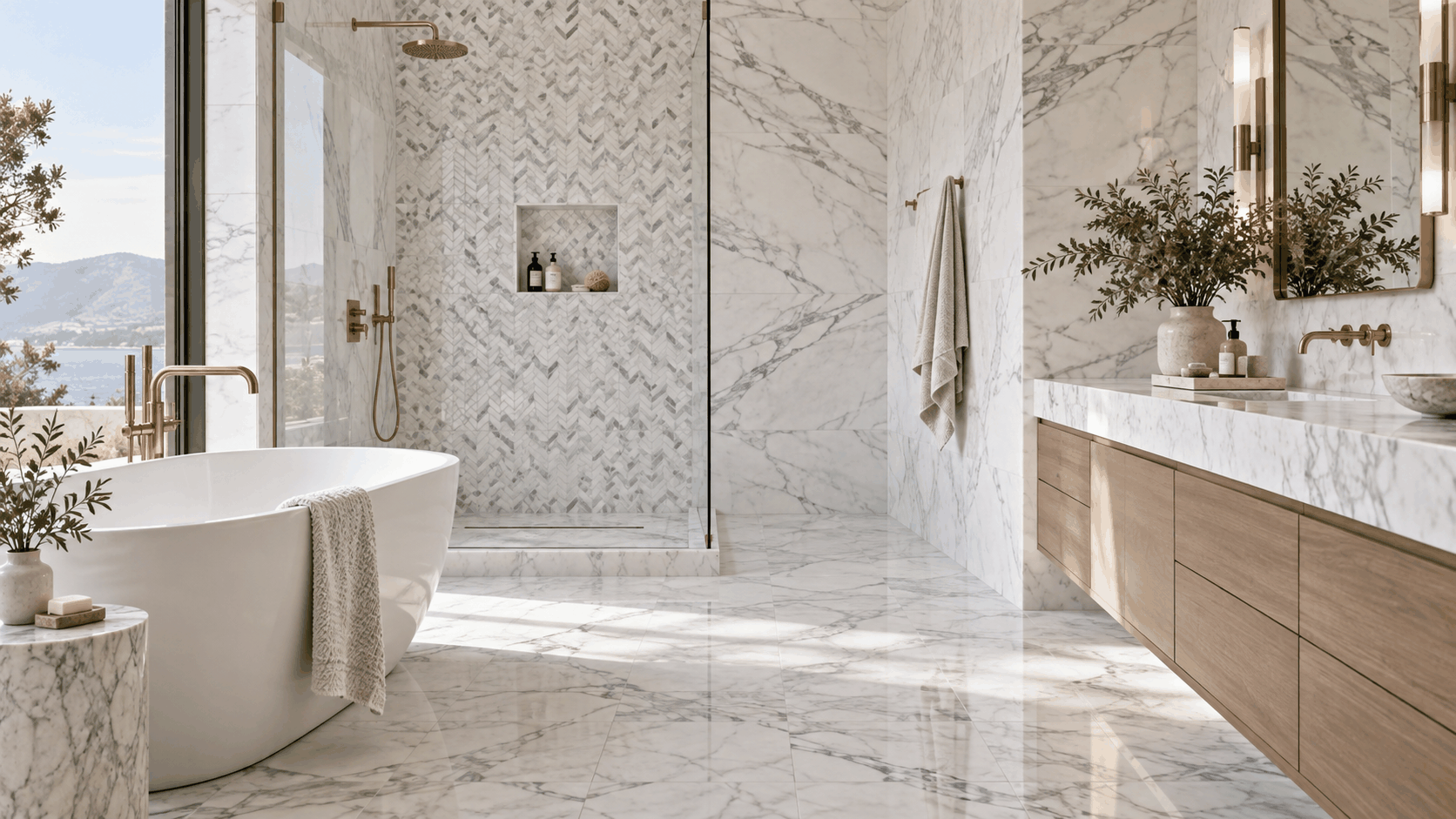
Marble has a quality that manufactured surfaces struggle to imitate. Look closely at a genuine marble tile and you will see subtle veins, clouds of color, tiny shifts in tone and details that were formed naturally rather than printed onto a surface. No two installations are exactly the same.
That individuality is also what makes buying marble slightly more complicated.
When you buy marble tiles online, you cannot simply choose “white marble,” calculate the square footage and expect every tile in the shipment to look identical to the photograph on your screen. Material, finish, pattern, tile size, natural variation and the intended room all matter.
Choose well, and marble can become the element that gives an entire interior its character.
Choose only by price or appearance, and you may discover halfway through installation that the stone is too glossy for the space, the variation is stronger than expected or you simply did not order enough material.
So what should you actually look for?
Why People Still Choose Real Marble
Interior trends come and go surprisingly quickly. Marble has survived centuries of them.
There is a reason.
Natural stone does not depend on a printed pattern to create visual interest. Every slab and tile contains genuine geological variation. Carrara may feature soft gray veining against a pale background. Calacatta can produce stronger, more dramatic movement, while clean white stones such as Thassos create a brighter and more minimal appearance.
This gives designers an unusual amount of freedom.
A marble floor can make an entrance feel formal and architectural. The same stone, cut into a small marble mosaic tile, can create an entirely different effect on a shower floor or kitchen backsplash.
And marble does not necessarily mean an extravagant room filled with stone.
Sometimes the most convincing design uses marble sparingly.
Imagine a kitchen with simple cabinetry, warm wood flooring and a restrained color palette. Instead of covering every surface with stone, the homeowner chooses a Calacatta Gold herringbone backsplash behind the range.
Suddenly that small section becomes the visual focus of the room.
“That’s the detail everyone notices first,” the homeowner might say six months later.
That is the strength of natural material: it can create impact without needing to dominate the interior.
What to Consider Before You Buy Marble Tiles Online
Shopping online gives you access to far more materials, dimensions and patterns than most local stores could realistically display. Surfaces Galore, for example, offers marble in different stone varieties, formats, mosaics and finishes ranging from polished and honed surfaces to more textured treatments.
But having more options means you need a selection process.
Before ordering anything, answer four questions:
• Where will the tile be installed?
• How much traffic or moisture will the surface experience?
• Do you want the marble to become a focal point or a quiet background?
• Are you comfortable with natural color and veining variation?
These questions eliminate unsuitable choices remarkably quickly.
A polished marble wall behind a vanity, for example, has different functional requirements from a shower floor that will regularly become wet.
Polished Marble: Light, Reflection and Drama
Polished marble has a glossy surface that reflects light and emphasizes color and veining. It can make white marble appear brighter and dark marble appear deeper.
This finish works particularly well when visual impact matters.
Think bathroom walls, decorative features, backsplashes or formal floors.
There is a trade-off, however. Highly polished surfaces can show marks more readily and may be less appropriate for certain wet-floor applications than finishes offering additional grip.
That does not make polished marble impractical. It simply means the room should determine the finish rather than the photograph.
Honed Marble: Softer and More Understated
Honed marble has a smoother matte or low-sheen appearance.
It often feels more relaxed.
Instead of reflecting every light source, it absorbs more of the surrounding visual environment. For contemporary bathrooms, kitchens and interiors where the designer wants natural stone without excessive shine, honed marble can be an excellent choice.
It also changes how veining appears.
The same stone may look more dramatic when polished and softer when honed.
This is one reason people who buy marble tiles online should look beyond color names. Finish is part of the design.
Marble Mosaic Tile: Small Pieces, Surprisingly Big Influence
Large-format marble has presence. Mosaic marble has personality.
A marble mosaic tile breaks natural stone into smaller pieces arranged into repeating patterns. Those patterns can be restrained and geometric or highly decorative.
Common choices include:
• Hexagon
• Herringbone
• Basketweave
• Penny round
• Arabesque
• Octagon
• Small square mosaics
Surfaces Galore carries marble mosaic options in stones including Carrara White, Calacatta Gold, Thassos and other natural materials, with designs suitable for backsplashes, walls, floors and shower areas.
The interesting part is how strongly geometry changes the character of the stone.
Take Carrara marble.
A traditional rectangular Carrara tile can create a calm European-style bathroom. Cut the same general material into small hexagons and suddenly the installation feels younger and more graphic.
Put it into a basketweave pattern and the mood changes again.
The stone provides the material; the pattern provides the personality.
When Mosaic Marble Makes the Most Sense
Mosaics are especially useful where smaller pieces provide either decorative or practical advantages.
A shower floor is a classic example.
Large tiles need to accommodate the slope toward the drain. Smaller mosaic pieces can follow that slope more naturally, while additional grout joints may provide useful traction depending on the material and finish.
Backsplashes are another obvious application.
Because a kitchen backsplash covers a relatively limited area, homeowners can often choose a more distinctive marble pattern without overwhelming the room.
This can also make premium natural stone accessible within a controlled budget.
You may decide that covering 600 square feet of flooring in a statement marble is unnecessary, while using 25 square feet behind a kitchen counter creates exactly the effect you wanted.
That is a sensible compromise rather than a downgrade.
Marble Tile for Sale: Price Should Not Be Your Only Filter
Searching for marble tile for sale usually brings price to the center of the decision.
Of course price matters.
Renovation budgets are real, and natural stone must compete with labor, waterproofing, cabinetry, fixtures, lighting and dozens of other expenses.
But the cheapest square-foot price does not automatically produce the cheapest completed installation.
Imagine two options.
Tile A costs slightly less but has significant variation that the homeowner did not expect. During installation, several pieces are rejected because they do not fit the desired layout.
Tile B costs more per square foot, but the buyer understood the stone's characteristics in advance and ordered an appropriate quantity.
The apparent bargain can disappear quickly.
When comparing marble tile for sale, evaluate:
• Stone type
• Finish
• Dimensions
• Thickness
• Coverage per piece or sheet
• Recommended application
• Natural variation
• Shipping considerations
• Additional quantity required for cuts and waste
This gives you a realistic project cost rather than a seductive product price.
Natural Variation Is Not a Manufacturing Error
This may be the most important concept for first-time marble buyers.
Natural marble varies.
Veins move.
Colors shift.
One tile may contain very little veining while the next piece contains a dramatic streak running almost from corner to corner.
Surfaces Galore specifically notes that natural stone can vary in color, veining, shade, size, thickness, finish and other characteristics. These variations are inherent to natural stone rather than necessarily being defects.
For some homeowners, that is precisely the attraction.
For others, it creates uncertainty.
“I want the floor to look exactly like the sample.”
With natural stone, that expectation needs adjusting.
A better goal is for the entire installation to feel visually balanced.
An experienced installer will often dry-lay or inspect pieces before fixing them permanently, distributing stronger and quieter patterns across the room instead of accidentally concentrating dramatic pieces in one corner.
This matters particularly with strongly veined marble.
Do not judge natural stone one tile at a time. Judge the composition.
Carrara, Calacatta or Thassos?
When you buy marble tiles online, several names appear repeatedly. Understanding their general visual character makes browsing considerably easier.
Carrara White
Carrara is one of the best-known Italian marble styles and is associated with a white to light-gray background and softer gray veining.
Its great advantage is versatility.
Carrara can fit traditional bathrooms, classic kitchens and contemporary interiors without automatically becoming the loudest element in the room.
For a homeowner who wants unmistakable natural stone but prefers restrained movement, Carrara is often worth considering.
Calacatta Gold
Calacatta Gold tends to attract buyers who want marble to make a stronger statement.
Its pale base may feature pronounced gray movement with warmer gold or beige tones.
It can look particularly effective alongside brass fixtures, warm woods or cream cabinetry.
A Calacatta Gold marble mosaic tile in herringbone or hexagon format can turn a relatively small wall into a centerpiece.
But there is a design warning here.
The more dramatic the stone, the less competition it usually needs.
Pair a heavily veined marble with highly patterned cabinetry, flooring and decorative surfaces and the room can become visually exhausting.
Let one material lead.
Thassos White
Thassos is attractive when brightness and a cleaner white appearance are priorities.
It can work beautifully in bathrooms where the goal is clarity rather than dramatic veining, and it can also be combined with darker marble to create strong geometric patterns.
Checkerboard designs are a good example of how contrasting stones can turn a traditional material into something bold and architectural.
How Much Marble Should You Order?
Ordering the exact measured square footage is risky.
Rooms contain corners. Tiles need cutting. Pieces may break during handling. Some sections of natural stone may not suit the visual placement you originally imagined.
That means additional material should normally be factored into the order.
The appropriate allowance depends on the room, pattern, tile dimensions and installation complexity.
A straightforward rectangular floor with a simple layout may generate relatively modest waste. A diagonal layout, herringbone installation or room containing many corners and obstacles may require considerably more cutting.
For complicated installations, asking the installer to calculate the material before you purchase can prevent two expensive mistakes:
ordering too much and paying unnecessarily, or ordering too little and discovering later that replacement material comes from a visibly different batch.
The second problem is often worse.
Natural stone from separate production batches may not match perfectly.
Therefore, when you buy marble tiles online, think about the complete project rather than the immediate square-foot requirement.
Large Tile or Mosaic? A Practical Bathroom Example
Consider a bathroom renovation measuring roughly 80 square feet.
The homeowner wants white marble everywhere but worries the room will feel cold.
Option one is to install identical large polished marble tiles across both floors and walls.
It will certainly look luxurious, but the result could become visually flat and highly reflective.
Option two creates contrast through format rather than color.
Use larger honed Carrara tiles on the main floor and walls, then introduce a smaller herringbone or hexagonal marble mosaic tile inside the shower or niche.
Now the entire room still belongs to the same material family, yet the different scale creates depth.
Add warm wood cabinetry and brushed metal fixtures.
The room feels considered rather than simply expensive.
This is a useful lesson: luxury is often created by proportion and restraint, not by covering every possible surface with the most expensive material available.
Should You Mix Marble Types?
Yes, but deliberately.
Mixing white marble with darker stone can create exceptional contrast. Checkerboard floors are an obvious example, but borders, shower niches and decorative inserts can achieve similar results.
The danger comes from combining too many variables simultaneously.
Different color.
Different vein.
Different finish.
Different pattern.
Different scale.
When everything changes, the room loses hierarchy.
A safer method is to keep two or three elements consistent.
For example:
Carrara field tile + Carrara herringbone mosaic.
The pattern changes, but the stone family connects the surfaces.
Or:
Thassos White + dark marble checkerboard.
The color contrast becomes the main feature, while the geometry remains disciplined.
Buying Marble Online Without Seeing Every Tile First
This is probably the biggest psychological obstacle.
People are used to buying manufactured products where one item should look almost identical to another. Natural marble does not work like that.
So how do you reduce uncertainty?
First, examine the product specifications carefully.
Do not rely exclusively on styled room photographs. Look at finish, tile dimensions, thickness, material and coverage information.
Second, understand what degree of variation is normal for natural stone.
Third, consider ordering samples when the project and supplier allow it.
Fourth, coordinate the final quantity with the installer before placing a large order.
And finally, stop expecting marble to behave like porcelain.
If identical repetition is your top priority, natural stone may simply not be the correct material.
There is nothing wrong with making that decision.
But if you appreciate subtle differences between pieces, those variations are not a problem to eliminate. They are the reason the completed surface looks natural.
Marble Tiles in Kitchens: Beauty Versus Everyday Reality
Kitchen marble generates strong opinions.
Some homeowners love the character it develops. Others want surfaces to remain visually perfect.
Tiles used as backsplashes are generally easier to live with than marble used as heavily exposed work surfaces because they experience different kinds of wear.
A polished marble backsplash behind a range can be spectacular. A mosaic can add texture without changing the kitchen's basic color scheme.
Still, natural stone needs appropriate care.
Marble can be sensitive to acidic substances, and the installation and maintenance approach should reflect where the stone is being used.
This is where expectations matter more than marketing language.
A family kitchen where children cook every day has different demands from a decorative guest bathroom.
Neither project is “better.” They simply need different material decisions.
Why Online Selection Can Actually Be an Advantage
At first glance, buying natural stone online seems counterintuitive.
Shouldn't you need a giant showroom?
Not necessarily.
A good online collection allows shoppers to compare multiple stone types, patterns, finishes and dimensions without being limited to whatever happens to be installed on ten showroom boards.
When you buy marble tiles online, you can move systematically between conventional marble tiles and decorative mosaics, compare Carrara with Calacatta, consider honed versus polished finishes and calculate which format makes sense for each part of the project.
That makes online purchasing particularly useful when the design requires multiple coordinated products.
You might choose:
• Large marble tile for the bathroom floor
• Matching subway tile for walls
• Herringbone mosaic for the shower niche
• Smaller mosaic for the shower floor
Everything can relate visually without being identical.
That is often how the strongest interiors are built.
Installation Can Make or Break Expensive Marble
Beautiful material cannot compensate for careless installation.
Natural stone requires planning.
Before installation begins, tiles should be inspected and the layout considered. Variation should be distributed intentionally. Cuts should be planned around focal points, corners and transitions.
Grout color deserves thought as well.
A grout close to the marble color allows the stone to dominate. A contrasting grout can emphasize geometric patterns, which may be desirable with hexagons or herringbone but distracting with strongly veined marble.
Then there is maintenance.
Different marble surfaces and applications may require specific sealing and cleaning approaches. Contractors or stone professionals should advise according to the exact product and location.
Spending carefully on material while cutting corners on installation rarely makes financial sense.
The installer is part of the finished product.
A Better Way to Shop for Marble Tile for Sale
Instead of opening dozens of products and asking, “Which one is cheapest?” reverse the process.
Start with the room.
Then define the aesthetic.
Then decide on finish.
Then choose scale and pattern.
Only after that should price narrow the shortlist.
This method protects you from buying something merely because it appears discounted.
A beautiful marble tile for sale is only a bargain when it actually belongs in your project.
When Marble Mosaic Tile Is Worth the Extra Detail
Mosaic installations generally contain more grout lines and may involve more installation attention than straightforward large-format tile.
Why bother?
Because detail changes perception.
A simple white bathroom can become memorable with a basketweave floor. An ordinary backsplash can gain movement through herringbone. A shower niche can become a deliberate architectural feature rather than a recess in the wall.
That extra detail is especially valuable in smaller spaces.
Powder rooms, entryways, niches and backsplashes give homeowners an opportunity to choose something more expressive because the material is concentrated in a limited area.
Sometimes 20 square feet of distinctive stone creates more impact than 500 square feet of predictable tile.
Buy Marble Tiles Online With a Plan, Not an Impulse
Marble rewards people who accept what it is.
It is natural.
It varies.
It requires thoughtful selection.
And when those qualities are treated as advantages rather than inconveniences, the results can be exceptional.
Before you buy marble tiles online, identify the room's functional requirements, compare polished and honed finishes, decide whether large-format tile or mosaic suits the space and calculate enough material for cuts, waste and visual selection.
If you want decorative impact, explore patterns such as herringbone, hexagon, basketweave or arabesque. If you prefer restraint, larger Carrara or similarly subtle marble formats may provide the quieter background you need.
Most importantly, look at the room as a complete composition.
The goal is not to find the most dramatic piece of marble on a product page.
The goal is to find the stone that still feels right when the cabinets are installed, the lights are switched on, the grout has dried and you have lived with the room for five years.
Surfaces Galore offers a broad selection of natural marble tiles and mosaics for buyers comparing materials, colors, dimensions, patterns and finishes. Whether the project calls for a classic Carrara bathroom, a Calacatta Gold feature wall, a geometric mosaic shower floor or a restrained natural-stone kitchen backsplash, having those choices in one place makes it easier to build a coordinated design.
If you are ready to buy marble tiles online, begin with function, narrow the choice by finish and format, account for natural variation and order with the complete installation in mind.
Great marble does not need to be perfect. It needs to be right for the space.